







The Hidden Mathematics of Brewery Production for STEM Students
 Story by:
Beer Blog
Story by:
Beer Blog
The art of producing beer might seem like it’s a craft of taste, timing, and tradition. For every batch, there is a mathematical system of measurement for mass, volume, temperature, acidity, sugar concentration, and losses. To a STEM student, the brewery can seem like a big lab where there are numbers to calculate and elements to carefully monitor and explain what finally ends up in the glass. For those interested in the science behind beer and what careful measurements contribute to the quality and character of a beer, this is an extra layer of interest in brewing. Involves commercial-scale synthesis, biology, physics, engineering, statistics, and data analysis.
Brewing Starts with Ratios and Conversions
A brewing recipe consists of a set of controlled ratios. Brewers measure the grain weight against the volume of water, the hop mass against the volume of wort, and the amount of yeast against the concentration of sugars. Those relationships ought to remain stable at increased production, much like the careful balance behind a seasonal release when a brewery brings a familiar beer back with its intended character intact. A recipe for 20 litres won’t simply be scaled up to 2,000 litres. Scale-dependent changes in heat loss, evaporation, and mixing are possible. Kilograms, litres, degrees Celsius, and grams per litre are also used by breweries. A single conversion mistake can change the bitterness, colour, fermentation rate, or alcohol percentage.
Mass Balance Tracks Materials and Losses
Mass balance follows a simple rule. Material entering a process must leave, remain inside the equipment, or become waste. During mashing, crushed grain and water enter the system. Liquid wort later leaves, while wet grain remains as a by-product. Water also disappears through absorption or evaporation. Brewers compare expected output with actual measurements. A large difference may reveal leakage, poor drainage, inaccurate sensors, or excessive boiling.
Turning Brewery Data into a Research Paper
STEM courses often ask students to turn production calculations into a formal research paper rather than submit equations alone. That task requires a clear question, reliable sources, explained assumptions, and logically structured arguments. A college essay writer can also be useful when students need help organizing complex technical material into a clear academic structure. A report might compare water use, extraction efficiency, energy demand, or fermentation losses across several brewery systems. Students must then connect numerical results with engineering decisions and environmental consequences.
During busy laboratory weeks, some learners consider online research paper assistance by EduBirdie while managing a research-driven writing process across several technical sections. Any submitted work should still match the course brief, citation rules, and institutional policy. Data must also remain traceable to credible studies or direct measurements. Careful checking matters because an elegant conclusion cannot repair incorrect units, weak evidence, or unsupported assumptions. The strongest brewery papers combine accurate mathematics with clear explanations of what each result means.
Specific Gravity Estimates Alcohol Production
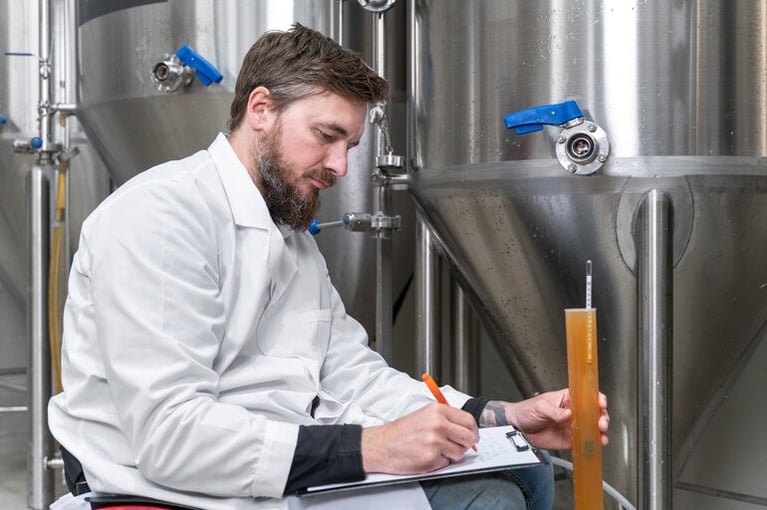
Specific gravity is a comparison of the densities of the wort or beer being brewed and water. The sugars that are dissolved in the wort make it heavier before it is brewed. As the yeast uses up those sugars, the density will decrease. Brewers keep a record of original gravity and final gravity. The difference allows the estimation of the amount of sugar converted to alcohol and carbon dioxide.
The most frequently used approximation is:
ABV = (131.25 × Original Gravity) – Final Gravity)
Original gravity is 1.050, final gravity is 1.010, and the estimated alcohol content is approximately 5.25 percent. Data from density measurements are indirect information about the inside of the fermenter. While a brewer wouldn’t be able to see every sugar molecule his yeast is harvesting, he can monitor the density to gauge progress and see how a batch is going. The readings make the invisible visible and measurable, making the science of brewing more real for anyone interested.
Heat Transfer Controls Brewing Temperatures
Temperature affects almost every brewing stage, making temperature control essential for consistency. Mash enzymes work within selected ranges, while yeast responds strongly to changes during fermentation.
Heating calculations often begin with:
Q = m × c × ΔT
In this case, the change in heat energy is represented by Q, the mass is represented by m, the specific heat capacity by c, and the temperature change by ΔT. The equation is used to calculate the energy needed for either heating water or wort. Real systems also lose heat from their walls and pipes, as well as the surrounding air. These losses are accounted for by the engineers. Energy can be used to help reduce fuel use through the heat exchanger by utilizing high-temperature liquid.
Fermentation Produces Curves, Not Straight Lines
Biology talks about fermentation; mathematics describes its behaviour. In yeast, the cells multiply and eat sugars, giving off carbon dioxide, and create flavour compounds. Initial growth of yeast can be exponential. Later, there aren’t enough nutrients, and more alcohol slows it down. Brewers control gravity, temperature, pH, and CO2 emissions. All batches will have their rate of progress indicated by the slope of each of the graphs. If a sudden plateau, it is unlikely that this is due to yeast activity, temperature too low, or insufficient nutrients.
pH Demonstrates Logarithmic Thinking
One of the aspects of brewing chemistry that is important is pH. The activity of enzymes can be influenced by the pH of the mash, and the activity of yeast cells and the stability of flavours are influenced by the pH of the fermented product. The pH scale is based on a logarithmic number system. It increases the number of H+ ions by a factor of 10 as the pH changes from 5 to 4. Brewers adjust pH by mineral additions, water treatment, or food-grade acids. Proper dose calculation and testing are needed to adjust the concentration. Responses may not be predictable if buffering compounds are used, and estimates should be compared to measurements.
Statistics Protects Quality and Consistency
One successful batch cannot prove that a production system is reliable. Breweries need measurements from many batches. Quality teams may track alcohol content, colour, bitterness, carbonation, fill volume, and fermentation time. Mean values describe typical performance, while standard deviation shows variation. Control charts separate normal fluctuation from unusual events. An extreme result may signal equipment failure.
A gradual trend may reveal wear, contamination, or changing ingredients. Testing every bottle may be impossible, so staff inspect a sample. Statistical methods help determine whether it represents the full production run. A one-millilitre overfill seems minor, but it becomes expensive across hundreds of thousands of containers.
Why Brewery Mathematics Matters to STEM Students
Ratios guide recipes, mass balances track materials, and density measurements estimate alcohol production. Heat equations support temperature control, while growth curves describe fermentation. Logarithms explain pH, and statistics protect consistency across packaged products. Together, these ideas form one practical mathematical system. Mathematics connects physical processes, biological behaviour, quality decisions, and business costs. A brewery turns abstract concepts into measurable outcomes.
Underneath the craft is a system of production, replete with equations, experiments, and reasoning. The fundamentals assist brewers in understanding how ingredients interact with each other, how to maximise efficiency in each part of the process, and how they can make informed modifications from one batch to the next. That degree of precision is a peek into the process of every beer for inquisitive imbibers.


Comments 0
No Readers' Pick yet.