


Craft Beer and Food Pairing: A Practical Guide for Home Entertainers
 Story by:
Beer Blog
Story by:
Beer Blog
The art of matching craft beer with food is such a skill that appears difficult to learn on the surface, but when you know several fundamental rules, it will become much easier to master. Craft beer has a very expansive palette of flavors, aromas, and textures, unlike wine; it has a flexible advantage in food pairing. This enables one to experiment more, to get a better balance, and still get the room to make bold and creative matches that enhance the overall dining experience. Do it right, and your dinner table will be discussed by guests even after the evening is over. The basis of a good pairing is the correlation between intensity and balance. A full-bodied, dense meal should have a full-bodied, full-character beer to support it, and a light meal should not have a full-bodied beer to support it.
The majority of the pairing failures happen not due to clashing flavours but as a result of one of the sides of the equation fully taking dominion over the other. Other than beverages and dishes, guests now demand an experience that extends continuously since the entrance to the last dish, including a well-thought-out playlist and conversation starters, and some gentle pre-dinner entertainment, such as a few rounds of helicopter X game online before everyone settles in to eat. A clear sense of how the evening will unfold lets you plan your beer selections around the full arc of the night rather than just the food.
The Core Principles of Beer and Food Pairing
The beginning of beer and food pairing is balance, where the flavors complement or contrast each other in a manner that maintains the palate at all times. Even the texture and intensity of lighter beers can be utilized with delicate dishes, while stronger styles can be used in favor of more intense dishes. Consideration of these elements will aid in generating combinations that are made purposely and not by chance.
Match Intensity First
A delicate steamed fish calls for something light and clean, like a Kölsch or a wheat beer. A slow-braised short rib can handle a robust stout or a strong Belgian ale. Thinking in terms of weight before flavor saves a lot of guesswork.
Use Contrast and Complement Strategically
Two strategies are likely to be successful, complementary, and contrasting.
- Complementary associations are tilted to common flavor, i.e., a caramel-forward amber ale together with a dish of sweet, roasted components.
- Opposite pairings. The beer is used to counteract richness, and the example of the tart, effervescent Berliner Weisse is used to serve a heavy charcuterie platter and cleanse the palate between bites.
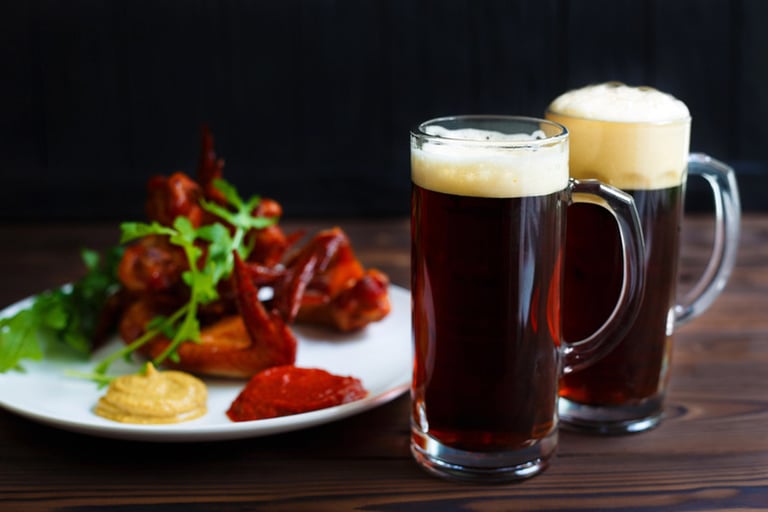
Particular attention should be paid to bitterness. It has a ripe hoppy IPA that may be a great remedy to richness and spiciness, so it makes it a great pairing with fried foods, spicy wings, and aged cheeses. The crispy, bitter hops edge allows the palate to be reset between bites to prevent heavy flavors from overwhelming the palate and also allows each item on the plate to remain individual.
Remember About Temperature
Lighter beers should be served colder, between 38 and 45 degrees Fahrenheit. Beers that are heavier, like stouts Belgium ales, are good at 50-55 degrees. Temperature is a small consideration that brings the flavours to ground in the manner desired by the brewer, and that is always worthy of raising the glass.
Pairing by Beer Style
By-the-beer-style is an easy method of creating combinations that are sure and do not make the process too complex. Every style has its balance of malt, hops, and body,y which naturally fits with some types of dishes. In such a way that it will be easier to align flavors intuitively and consistently, knowing these general profiles.
- Lagers and Wheat Beers
They are your most all-around starters. Wheat Ale beers and light lagers are suitable beers with salads, soft cheeses, grilled vegetables, and seafood. They also go well with the early evening, which is when people are snacking, and the palate is still fresh. Hummus, pita, and fresh herbs with a Hefeweizen are a combination that can hardly go wrong.
- IPAs
One of the most food-friendly in the craft market is the India Pale Ale, which, mostly due to its bitterness, cleanses the palate. They are well paired with the spicy foodstuff, fatty meat, and hard cheeses such as old cheddar or blue cheese. A slightly softened New England IPA is just the right choice with tacos of citrus-marinated chicken or fish.
- Stouts and Porters
Dark beers pair well with heavy, dense cuisines. One of the best-known of all beer-culture pairings is a dry Irish stout with oysters; this is as well-deserved an honor as it earns. Chocolate stouts are surprisingly good as a dessert match, mostly with dark chocolate, brownies, or just a scoop of plain vanilla ice cream, and the balance of temperature and sweetness does the work in most cases. For an even richer experience, try applying stout and chocolate pairing tips to better match bold, roasted beers with equally indulgent desserts.
- Sours
The wild card to any pairing menu is the use of sour beers, but they are worth trying. Being acidic in nature, they go well with soft cheeses, sweet fruits, and food with a vinegar-based sauce. The lightness and tartness of a Gose would be good with a light seafood ceviche or summer fruit salad.
How to Set Up Your Pairing Menu?
To plan a complete pairing menu for a dinner party, one does not need an expert level of knowledge. It is best to start with three or four beers, which enhances the brewing experience, spans the spectrum of styles, and builds your food menu around those selections so that there is a natural transition between one course and another. A little explanation of why this particular match is a great choice will provide guests with some content to occupy their time and make the meal look far more like a casual conversation than a formal tasting.


Comments 0
No Readers' Pick yet.